
Critique of ‘Agentic’ Reason
Silicon Valley’s war on introspection

This week, the venture capitalist Marc Andreessen declared war on “introspection.” His philosophy, he explained, is: “Move forward. Go! … People who dwell in the past get stuck in the past.” He went on to offer the following historical excursus:
If you go back 400 years ago it never would’ve occurred to anybody to be introspective. All of the modern conceptions around introspection and therapy, and all the things that kind of result from that are, a kind of a manufacture of the 1910s, 1920s. Great men of history didn’t sit around doing this stuff. The individual runs and does all these things and builds things and builds empires and builds companies and builds technology. And then this kind of guilt based whammy kind of showed up from Europe. A lot of it from Vienna in 1910, 1920s, Freud and all that entire movement. And kind of turned all that inward and basically said, okay, now we need to basically second guess the individual. We need to criticize the individual. The individual needs to self-criticize. The individual needs to feel guilt, needs to look backwards, needs to dwell in the past.
In 1626—400 years ago—Francis Bacon published The New Atlantis, an early manifesto of the modern technoscientific project, which Silicon Valley claims to carry forward. The previous year, Bacon had published the third edition of his Essays. The essay, as a literary genre, had been invented by Michel de Montaigne the previous century, and Bacon was largely responsible for importing it into English. The essay form is often taken as one of the birthplaces of the modern self, usually understood as a self that reflects on itself—“criticizes” and “second-guesses” itself, as Andressen puts it; that poses to itself Montaigne’s question “what do I know?”
By most accounts, “introspection” and, more broadly, the cultivation of a rich inner life were central to the emergence of the modern individual. One could tell many stories about this, ones involving the Reformation’s emphasis on faith, prayer, and the solitary reading of scripture, enabled by the technology of the printing press, another involving the Renaissance rediscovery of ancient philosophy and the ideal of the examined life. It is also broadly accepted that these developments occurred in complex interplay with the modern enterprise of asserting control over nature through scientific understanding and technological invention. Hence, René Descartes, who along with Bacon laid the intellectual groundwork for the Scientific Revolution, began his project with the Meditations on First Philosophy (1641). This text famously begins by looking inward, establishing the certainty of the self before attempting to do the same for knowledge of the natural world. We could cite any number of examples, perhaps culminating in the work of Immanuel Kant, in which critical self-reflection, scientific knowledge, and the practical mastery over the world were regarded as complementary efforts.
For decades, the idea that you could make things in the world while also looking inward was common enough in Silicon Valley, whose early culture drew heavily from Northern California’s post-’60s spiritualism. But evidently, this notion has fallen out of fashion. In a recent Harper’s reportage, Sam Kriss describes the ascendant culture as follows:
An AI might be able to code faster than you, but there is one advantage that humans still have. It’s called agency, or being highly agentic. The highly agentic are people who just do things. They don’t timidly wait for permission or consensus; they drive like bulldozers through whatever’s in their way. When they see something that could be changed in the world, they don’t write a lengthy critique—they change it.
Kriss’s case study is Roy Lee, who was kicked out of Columbia University after developing an AI tool for cheating in job interviews. He also cheerfully admitted to have used AI to do all his work, and to write the essay that got him into Columbia. He is now building a startup, Cluely, whose AI tool promises to coach users in real time through every interaction, whether a date or an interview. Lee prides himself on being highly “agentic,” but as Kriss notes, he is designing a tool that promises to outsource all agency to machines. “Here was someone,” says Kriss, “who reacted very violently to anyone who tried to tell him what to do. At the same time, his grand contribution to the world was a piece of software that told people what to do.”
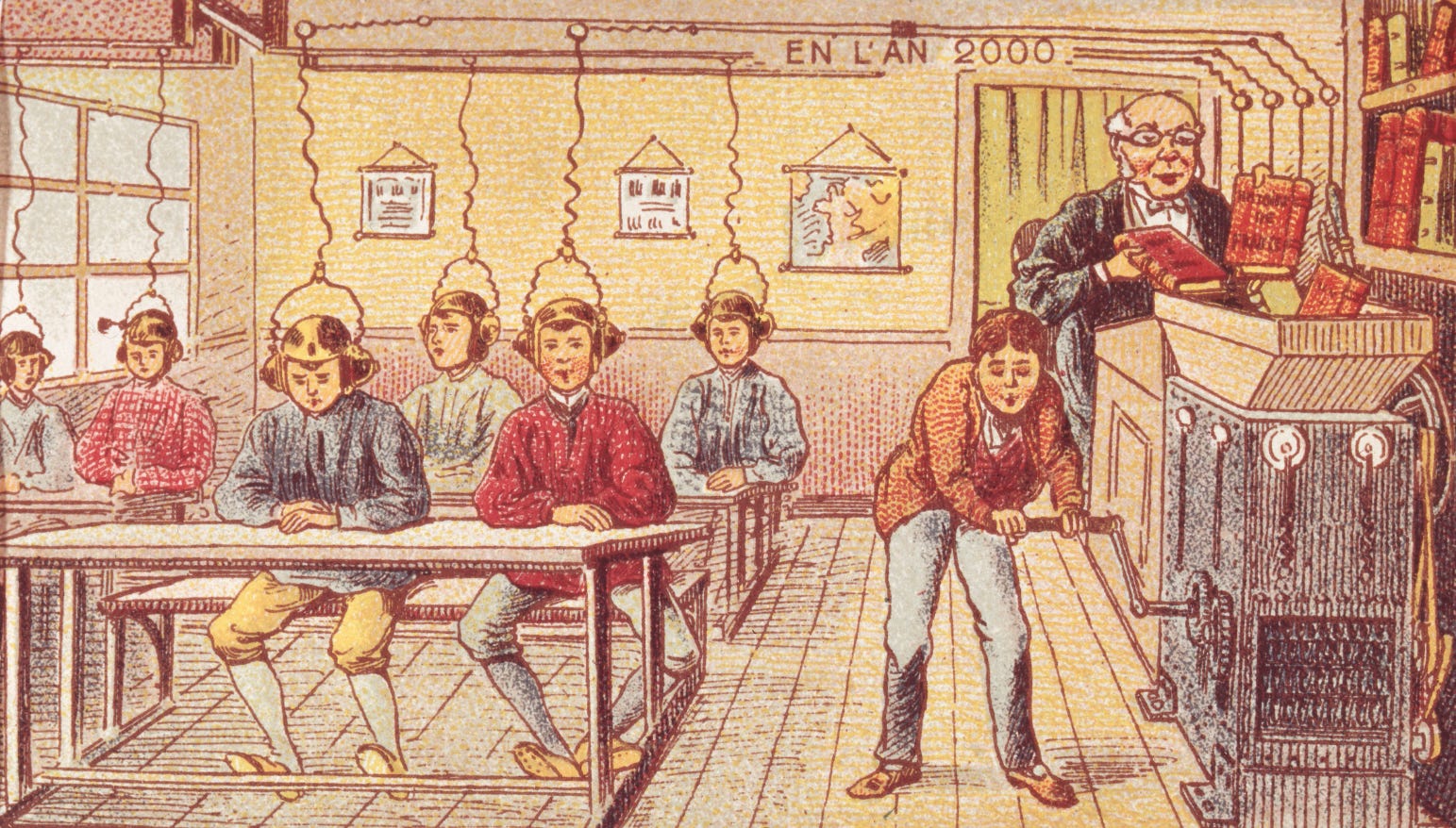
I’m not sure this is, as Kriss says, a “glaring contradiction.” In the world envisioned by Andreessen and Lee, some individuals may have an active role to play alongside AI “agents,” as one source of the electrical pulses that feed into the functioning of the burgeoning machinic system we now call “intelligence.” They may frame this activity as a great man theory of technological history, but it is if anything the opposite. It envisions human beings reduced to stimulus-response machines, their subjectivity and individuality evacuated, their functions unbundled and offloaded to AI tools. The greatness of great men of history, by many earlier accounts, derived from their capacity for reflection in addition to action—Caesar not only conquered Gaul but wrote a masterwork of Latin prose about it; Napoleon brooded over Goethe’s Sorrows of Young Werther as he conquered Europe. In contrast, all that evidently makes a few “agentic” humans stand out is the strength of the electrical pulses they feed into the system. Any energy they expended on extraneous inward reflection merely subtracts from these contributions.
Max Horkheimer and Theodor Adorno foresaw much of this in Dialectic of Enlightenment. Writing around the time Alan Turing was laying out the rudiments of computer science, Horkheimer and Adorno described a process by which “[t]hinking objectives itself to become an automatic, self-activating process; an impersonation of the machine that it produces itself so that ultimately the machine can replace it.” As a consequence, Bacon’s “utopian vision that we should ‘command nature by action’” degenerates into a project of universal mechanical domination in which humanity itself becomes another object to be administered, thereby losing the freedom it was promised. Enlightenment, and the technoscientific subjugation of nature on behalf of human freedom, gives rise to a new servitude. “The enforced power of the system over men,” they wrote, “grows with every step that takes it out of the power of nature.” Even the “agentic” among us are, by their own account, mechanically pursuing the imperatives of the system they are building. Seen that way, their aversion to reflection is hardly surprising.
This week in Compact:
Me on Habermas and the tech right
Matthew Cavedon on the fear of disability
Darel Paul on the legacy of Paul Ehrlich
Conor McGlynn on Lewis Mumford and AI
Leo Greenberg on “fortress liberalism”
Why don't we just ignore these people?
It's not as if they were cultured.
They are just rich.
If philosophers like Byung-Chul Han have taught me anything. It's that we live in a society that is overstimulated and are in desperate need of studied boredom and self reflection. To me, Marc Adreessen seems driven to turn the average person into creatures of instinct. That scares me. To obey without question, to act on impulse, it has it's place and uses. Yet to hoist that on society in general is insane if you ask me.