
The Left’s Groyper War
Gabriel Rockhill is the left’s Nick Fuentes

The inauguration of Zohran Mamdani this week seemed to signal a new era of ascendancy for the American left, which not long ago was written off as a spent force. With Bernie Sanders, AOC, and other luminaries in attendance, the new mayor’s swearing seemed to show a united front. But online, the left looked more divided—not least over the new book by the Villanova philosophy professor Gabriel Rockhill, Who Paid the Pipers of Western Marxism?
Rockhill and his defenders are quick to accuse critics of misrepresentation, so I will rely on the book’s jacket copy for a summary of the basic argument. The publisher, Monthly Review Press, describes it as
a meticulous counter-history of the Frankfurt School … situating it within the global relations of class struggle and the imperialist war on actually existing socialism. With the explicit and direct backing of powerful elements in the capitalist ruling class and the world’s leading imperialist state, the Frankfurt School developed a widely promoted form of compatible critical theory as an ersatz for dialectical and historical materialism … Rockhill’s book elucidates how the intellectual world war on the socialist alternative has sought to shore up and promote a “compatible left” intelligentsia while misrepresenting, maligning, and trying to destroy the revolutionary left.
In my own terms, what Rockhill offers is a mirror image of the right-wing “Frankfurt School conspiracy theory,” according to which the group of philosophers in question undermined capitalism from their perches within Western institutions. Rockhill, conversely, claims that the Frankfurt School undermined global communism in service of Western capitalism. What Rockhill means by “the socialist alternative” isn’t some pie-in-the-sky utopian fantasy: He means the “actually existing socialism” of the Soviet Bloc (in the Frankfurt School’s own era) and China (in ours). His complaint about the Frankfurt School and the sorts of Marxism descended from it is that they fail to endorse the “anti-imperialist” state socialist projects opposed to Western capitalist hegemony, and thereby capitulate to the latter.
Rockhill’s Frankfurt School theory has certain advantages over its right-wing counterpart, in part because, unlike Mark Levin or Glenn Beck, he actually knows the subject matter. It is indeed the case that the Frankfurt School philosophers weren’t bomb-throwing revolutionaries. Adorno and Horkheimer were culturally conservative, hostile to both the Soviet Union and the New Left, and suspicious of revolutionary movements and mass politics. In these and other respects, this sort of Marxism was indeed “compatible” with Western capitalist societies, and it isn’t surprising it found a foothold in academia and attained a certain intellectual respectability. The Frankfurt School style of cultural critique was easily merged into generic highbrow suspicion of mass culture, the soft anti-capitalism endemic to modern intellectual life since the 19th century. (As an aside, though, the “cultural studies” turn of the 1980s saw culturally populist proto-“poptimism” triumph over Adorno-style mandarin attitudes on the academic left.)
Marcuse, whose CIA and Rockefeller funding Rockhill documents at length, was no fan of Eastern Bloc “actually existing socialism,” but unlike his colleagues, he did see considerable promise in the New Left movements that came to a head in 1968—which returned the favor by, for instance, parading around with banners that read “Marx, Mao, Marcuse.” But precisely because of this mutual admiration, it seems odd to claim that Marcuse was a functionary of the Western capitalist order tasked with seducing the youth away from the glorious promise of Soviet communism. The New Left that was influenced by Marcuse may not have been all that entranced by Brezhnev, but it was enraptured by the “anti-imperialist” politics to which Rockhill also subscribes, which had its capitals in Havana and Algiers. Despite their aesthetic differences from the dour bureaucrats of Moscow, Che, Fidel, and Arafat were beneficiaries of their largesse. What’s more, Marcuse’s most famous student, Angela Davis, was on cozy terms with the apparatchiks of “actually existing socialism.” So I’m not sure the CIA’s cash was well spent.
Why does any of this matter today? You don’t have to take it from me—people on the left are arguing passionately online about Rockhill’s book, so it seems to have struck a nerve. In practical terms, I think it boils down to the question of what the left should be today. For Rockhill and his allies, the correct political path is a sort of neo-Third Worldism aligned with Beijing, Havana, Caracas, and the other redoubts of “actually existing socialism”—a continuation of the outlook referred to in the twentieth century as “campism.” This outlook has a lot in common with the multipolarism espoused in certain corners of the right (which I wrote about recently here).
Rockhill and his allies present themselves as defenders of concrete “state-building projects” (like that of the Chinese Communist Party) over and against the “utopian, populist, or rebellious anarchist-inflected versions of socialism” long popular on the Western left. But what does their project amount to politically within the West itself? Mainly, it seems to mean rooting for the victory of the West’s enemies. Rockhill—and here he actually agrees with the Frankfurt School—thinks the “labor aristocracy” of the imperialist core has been bribed and bamboozled into aligning itself with the bourgeoisie rather than “the proletariat in the colonial and semicolonial periphery.” A political project by and for the American working class—ostensibly, what ordinary left politics claims to offer—would thus seem to be at odds with his vision.
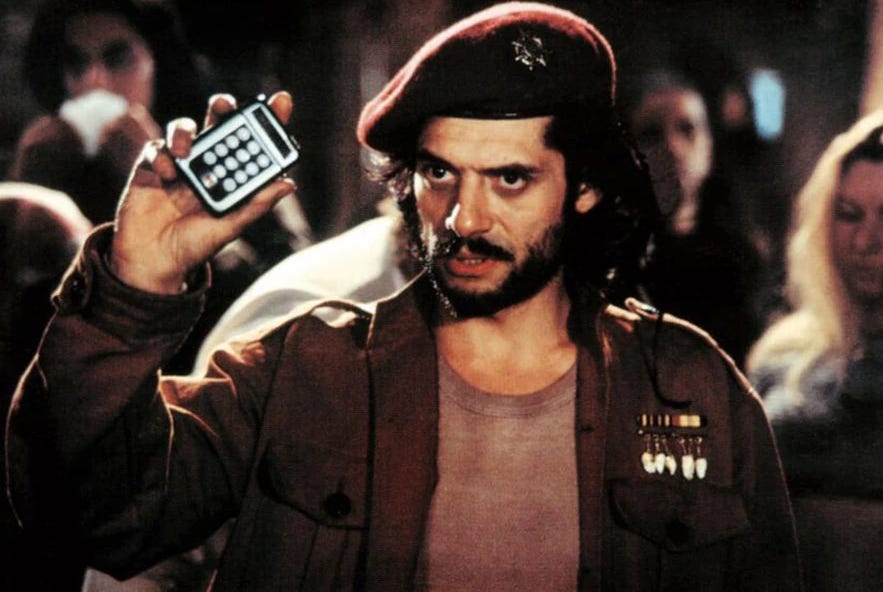
It is here that Third-Worldists unwittingly lend support to the far right ideologues who now control, among other things, the Department of Homeland Security’s X account. The only conceivable vision of revolution within the West implied by Rockhill’s anti-imperialism would seem to be something like the scheme of Cuervo Jones, the Che-esque villain of John Carpenter’s Escape From LA, who commandeers a satellite-based superweapon to facilitate an invasion of North America by a vast Third World flotilla. Something close to this, of course, is also the plot of Jean Raspail’s Camp of the Saints, a key reference for today’s right. Campists and groypers alike view the world as locked in a zero-sum battle between “the West” and the Third World; they only differ in which side they prefer to win.
This week in Compact
James Hankins on leaving Harvard
Éric Zemmour on Brigitte Bardot
Nathan Pinkoski on Trump vs. Brussels
Jacob Eisler on electoral integration
Matthew Dal Santo on Armenia
Lisa McKenzie on Cologne
Frank Furedi on militant centrism
This is interesting, and I was totally unaware of it. I try to stay up on left-liberal discourse, but of course that means I miss a lot of left-illiberal discourse. Not on bluesky, etc. So Geoff if you've got time to share some examples of the discourse around this that'd be really illuminating!
On the substance, hasn't this argument about the Frankfurt school been made before? I see it as a pretty central thesis in e.g. Musa Al-Gharbi's project in We Have Never Been Woke. You can even see it in Rufo's stylized history of America's "Cultural Revolution."
Could the hand-wringing really just be that the illiberal left is reckoning with the following trilemma: either they continue their current anti-anti-imperialist complicity that prioritizes identity politics over class politics; or they go all in on historical materialism; or they abandon the revolutionary critical project and just become incrementalist liberals.
They obviously don't want to grasp the second horn because that'd be too professionally and socially de-stabilizing, nor do they want to compromise their moral convictions and grasp the third. So they'll end up in a position where they need to frantically deny Rockhill's arguments.
"Respect," "defend" – that's just semantics. I'm not dug in to my position here. What standard we ought to apply when evaluating the USSR across its lifespan is a hard question to answer. Comparing it to "true socialism" is impossible because true socialism is global and does not exist (I'm not at all sure it can). Whereas, comparing it to more gentle experiments in social democracy is comparing apples to oranges, because of the obvious differences in underdevelopment, encirclement, exposure to existential threats. As for achievements, those you listed are pretty big, and there's one other worth mentioning, which is that the USSR helped keep socialism and anticolonial struggles alive in the Third World