
The NatCon Con
Neither national nor conservative

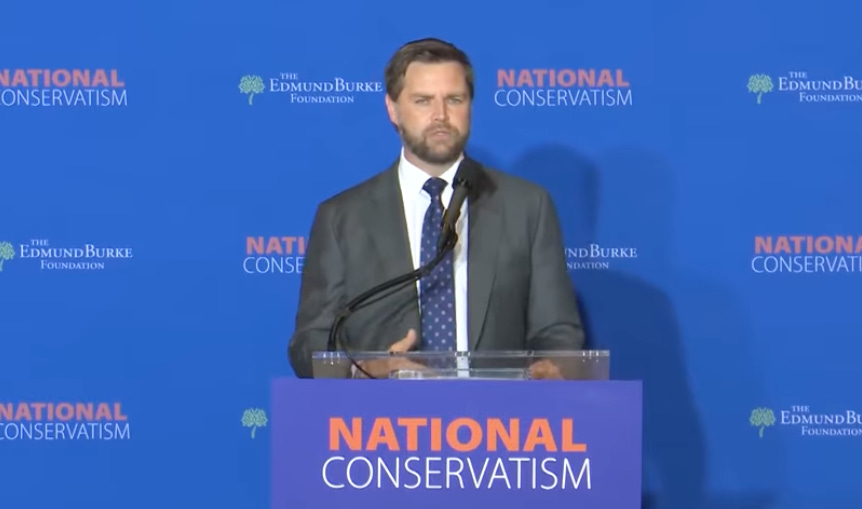
National Conservatism is the most successful of various attempts by intellectuals to articulate a shared rationale for the right-populist movements that rose up in the course of the 2010s. Having begun as a motley rebel alliance against liberal internationalism, with last year’s presidential election NatCon seemed to have won a decisive battle in that war. At its first post-election gathering, the organization looked like an extension of the Trump White House, featuring many top administration figures as keynote speakers.
Yet this moment of triumph has also become one of crisis, mostly due to the right’s internal schism over Israel. That’s why Yoram Hazony, the movement’s Israeli-born, US-educated ideologue-in-chief, found himself in damage control mode during the crack-up that followed the assassination of Charlie Kirk. Hazony’s problem was that he had founded a movement oriented around principles including “national independence” and “rejection of imperialism and globalism,” but was shocked, shocked to find out that many of those attracted to some of the ideas driving the movement also viewed Israel not as a proud independent nation with an indelible spiritual kinship with the United States (Hazony’s view) but as another instrument of “globalism” that compromised America’s own independence.
NatCon’s contradictions were on display in a slightly less obvious way this week, in the wake of the Trump administration’s surprise operation to apprehend Nicolás Maduro. Shortly after that, Hazony announced he was taking time off from social media due to a death in the family, but seemed concerned to convey that this was not because he didn’t want to weigh in on Venezuela. He declared that he “fully support[s] the Trump administration’s decision to arrest [Maduro] and try him on terrorism and drug trafficking charges.” It isn’t hard to see why he felt it necessary to state his view given his erstwhile outspoken opposition to “imperialism.” But he left a great deal unclear. The arrest of Maduro was one thing, but Trump has also declared Venezuela a de facto protectorate of the United States, seemingly in line with his ambition to revive America’s imperial projects of a century ago.
Some NatCon-aligned politicians seem alarmed about this. Marine Le Pen declared that “state sovereignty is never negotiable,” and that “to renounce this principle today … would be to accept our own servitude tomorrow.” Even close Trump buddy Nigel Farage described the Venezuela action as “unorthodox and contrary to international law.” It doesn’t seem surprising that Euroskeptic politicians might be concerned about the Trump administration’s vision of the new world order. Although Trump and his surrogates love to rail against Brussels, if the new guiding principle of international relations is that regional hegemons now enjoy uncontested sway within their sphere of influence, that might seem like a good deal for Germany and a bad one for, say, Brexiteers who want to expand trade with other parts of the world.
We can find a preview of these conundrums in Hazony’s manifesto The Virtue of Nationalism, which appeared in 2018, the year before the first of the annual NatCon gathering. In one section of the book, he discusses Brexit (Farage’s moment of triumph) to illustrate the crypto-imperial character of liberal internationalism:
The alarm and trepidation with which European and American elites responded to the prospect of an independent Britain revealed something that had long been obscured from view. That simple truth is that the emerging liberal construction is incapable of respecting, much less celebrating, the deviation of nations seeking to assert a right to their own unique laws, traditions, and policies.
But once he moves on from Brexit, the argument takes a surprising turn:
Nor is Britain the only nation to have felt the sting of this whip. America is hardly immune: Its refusal to permit the International Criminal Court to try its soldiers, its unwillingness to sign international treaties designed to protect the environment, its war in Iraq—all were met with similar outrage both at home and abroad. Such outbursts have long targeted Israel, whether for bombing Iraq’s nuclear facilities or for constructing housing complexes in eastern Jerusalem.
To be sure, the first two examples—Washington refusing to join the ICC and the Kyoto Protocol—are not unlike Britain exiting the European Union, since all involve disassociation from transnational organizations. But the third—the war in Iraq—is strikingly different: It involves a state deliberately involving itself in the affairs of another country, rather than freeing itself from other countries’ meddling in its own. The “outrage” about Iraq, which Hazony so casually dismisses, was often enough articulated in terms of precisely the principle to which he himself as well as the advocates of Brexit often appeal: the inviolability of national sovereignty. Something similar is true of the Israeli examples: Many of those objecting to them argued that Israel was violating the sovereignty of other nations by preemptively striking foreign nuclear facilities or de facto annexing disputed territories.
There are plausible retorts that could be made to such criticisms of US and Israeli foreign policy, but Hazony’s is not among them. His claim is that by invading and occupying Iraq, bombing Osirak, or building settlements in the West Bank, the United States and Israel are simply “assert[ing] a right to their own unique laws, traditions, and policies.” The problem here seems obvious. What if my country’s “unique laws, traditions, and policies” include aggressive interference in the internal affairs of other nations, or for that matter, simply conquering and plundering foreign territories? That would surely pose problems for Hazony’s “world of free and independent nations.”
This isn’t an imaginary position: It’s currently fashionable in some corners of the far right to contend that what defines “the West” is its penchant for imperial conquest. As I wrote about recently, one source of this idea is Oswald Spengler’s “Faustian” account of the West as characterized by “a constant reaching beyond itself—a restless dissatisfaction with territorial, cultural, and intellectual limits.” Some right-wing influencers cited roughly this reasoning in defending the Venezuela escapade this week.
Such a view might seem to be flagrantly at odds with the principles of “national conservatism” as Hazony defines them. In The Virtue of Nationalism, he contrasts his preferred international “order of independent nations” with an “imperial order” in which “a single imperial state regards itself as justified in dictating a law to all nations and in enforcing this law according to its own understanding.” However, as we have already seen, he also provides a loophole where some nations, by virtue of their “unique laws, traditions, and policies” may take on what can only be described as an imperial role.
Inconveniently for any attempt to differentiate Trumpian nationalism from imperialism, Trump has repeatedly said his model for his second term is William McKinley. Here is what Hazony had to say about that predecessor:
Under President William McKinley, the United States resolved to become a world empire with a mission to bring its cultural inheritance of Christianity and capitalism to the uncivilized reaches of the globe. In the name of this great vision, the United States conquered the Philippines, Cuba, Puerto Rico, and other island possessions of the Spanish Empire, only to meet with tenacious military resistance. Americans, who had regarded themselves as liberators, found themselves mired in a series of wars of colonial repression. The powerful disdain for foreign empires that had originally given birth to the United States reasserted itself.
It might be objected that whatever Trump’s wistfulness about McKinley, the administration’s limited law enforcement operation in Venezuela is not a revival of this earlier project of “dictating a law to all nations.” One problem with this is that Trump immediately followed up the Maduro capture by proclaiming, first, that Washington was now “running” the country, and second, that he might do the same to various other heads of state if they didn’t fall in line. The fact that he isn’t seeking to directly conquer and rule “all nations” doesn’t mean he isn’t trying to “dictate a law” to them.
Despite his ardent defense of the Iraq War in The Virtue of Nationalism, Hazony is eager to differentiate his—and the Trump administration’s—approach from that of the Bush administration. At the most recent NatCon, he declared: “Nobody’s a neocon here. We’re not doing George Bush 2.0.” One way some in the Trump orbit support this claim is to say that whereas Bush wanted to impose America’s will on faraway lands, the “Donroe Doctrine” entails a retrenchment to the Western Hemisphere. There are a few issues with this. One is that America remains deeply embroiled in conflicts across the globe. “Running” Venezuela hasn’t replaced Ukraine and the Middle East; it’s been added to the list of foreign entanglements. Another is that Trump, who recently ordered a strike in Nigeria and has been threatening to do the same (again) in Iran, doesn’t seem to be particularly keen to limit his conception of America’s reach to this hemisphere.
Another problem with the “Donroe Doctrine” relates to the NatCon “nationalist internationale” as a whole. This brings us back to the concerns voiced by Le Pen about the violation of Venezuela’s sovereignty. Beyond Trump, some of the most successful NatCon-aligned political projects are to be found in Eastern and Central Europe: Viktor Orbán’s Hungary, Poland’s long-governing Law and Justice Party. If the new guiding principle of international order is that regional hegemons should enjoy broad leeway to coerce, pressure, and if necessary invade smaller countries in their vicinity, that arrangement doesn’t seem ideal—to say the least—for countries stuck in the historically conflict-ridden territories between Brussels and Moscow.
Unlike Le Pen, Orbán declared his support for the Venezuela intervention. But this was something of a reversal. Just a few years ago, he dispatched his foreign minister to Caracas; subsequently, Hungary was accused of blocking an EU declaration condemning Maduro’s fraudulent reelection. There was a certain logic to a low-key alliance between two nations so often at odds with their respective regional hegemons. Hungary, in the orbit of Brussels, wants to be able to enjoy good diplomatic and commercial relations with China, Russia, and the United States. Venezuela, under Chavismo, sought autonomy from the Washington Consensus, and hence established strong relations with China and Russia. It is precisely to prevent that from continuing that Trump is now planning to “run” the country—and its oil industry—indefinitely.
It isn’t particularly hard to see the contours of the global order favored by the various NatCon-aligned politicians currently in power because it doesn’t seem all that different from the one that preceded it. In it, the United States retains global primacy, but selectively deploys the NatCon language of “national independence” and “sovereignty” when that is useful to curb the influence of nations and institutions that it views as hostile. What this looks like is a system update to Global American Empire in which Washington dispenses with the (varyingly cynical and inconsistently applied) framework that previously defined foreign policy and replaces it with an even more erratic one that often enough just looks like atavistic chauvinism. What it doesn’t look like is Hazony’s “order of independent national states.”
This week in Compact
Juan Rojas on the Maduro ouster
John Londregan on US Latin America policy
Chris Cutrone on the prospects for a new pax americana
Germán Díaz del Castillo on why Mexico defunded daycare
Philip Cunliffe on foreign policy realism
Helen Andrews on Somali culture
Charles Murray on assisted suicide
Nateocons
Great analysis.