
We Need a MAGA Left
The symbols of midcentury American prosperity remain potent, and up for grabs

Two Thanksgiving posts caught my attention yesterday:
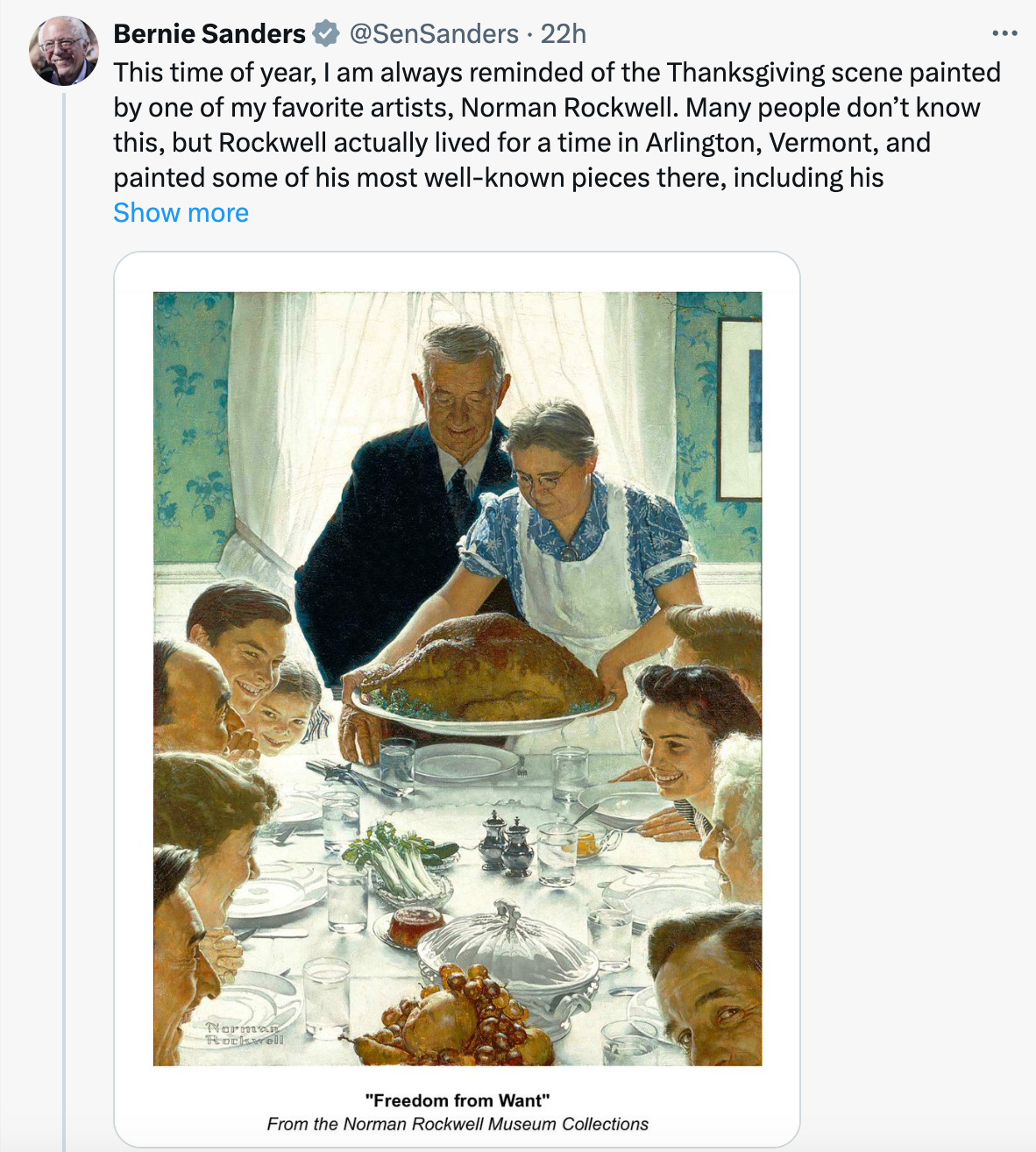
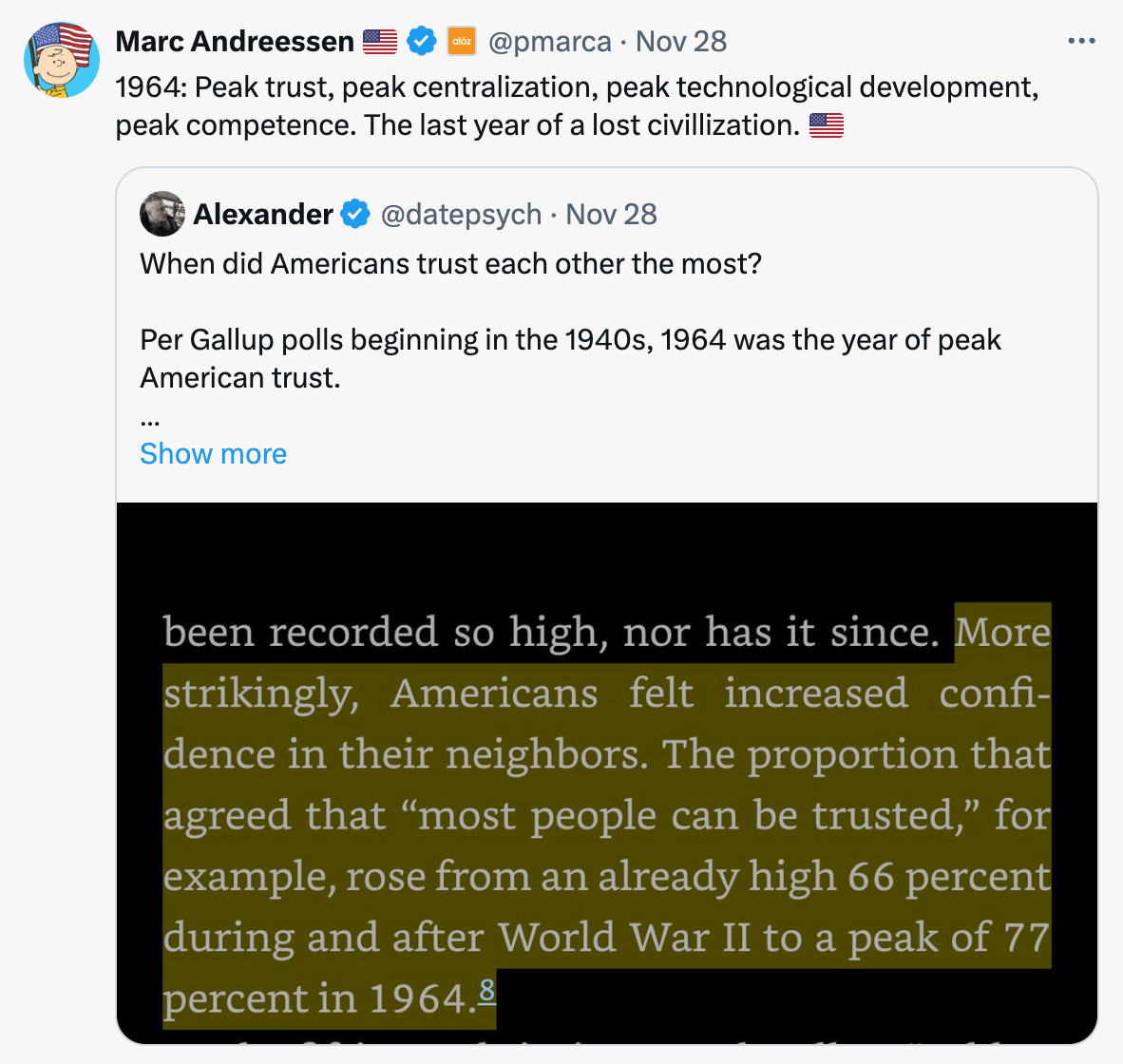
In a way, they are two versions of the same post. Andreessen is a Trump-supporting “billionaiah,” and Bernie Sanders is Bernie Sanders, but both are looking back nostalgically to the high point of midcentury American prosperity; both seem to regard returning to something resembling that state of affairs as the main task of politics, even as their policy prescriptions are likely to be about as far as you can get, particularly on the economic front.
This sort of thing has been going on for a long time. I remember being initially aware, way back in the 90s, of “the 1950s” as something conservatives like Bob Dole got dewy-eyed about. Then at some point I realized that if you read op-eds by progressive policy types, they often also get dewy-eyed about the 50s, just about different aspects of that era: peak union density and high marginal tax rates, rather than family values and church attendance. I think I made this realization around the time Robert Putnam published Bowling Alone, which has since become the obligatory reference in such discussions.
When I first encountered “Make America Great Again” as a campaign slogan just shy of a decade ago, all of this came to mind. Prior to that, right and left had each had their own distinct “MAGA” politics; the right’s was mainly about morality, the left’s mainly about economics. In his unsystematic, improvisational way, Trump offered a partial synthesis of these strands of political discourse. From the right-wing version of midcentury nostalgia, he took on the patriotism while downplaying the moralistic scolding that had become a major drag on the GOP brand by the 2010s; he didn’t take on the left’s advocacy for Eisenhower-level tax rates (to say the least), but he steered clear of backing entitlement cuts while also acknowledging that Reaganite economics had made things worse for people and advocating a restoration of American industry, the heart of the midcentury economic order.
In posting the iconic Norman Rockwell painting, Sanders inadvertently offered a reminder of the failings of his own populist insurgency. His attempt to articulate a distinct economic populist version of “MAGA” was sabotaged by the boutique cultural politics of his coalition, as well as by his own dogged loyalty to the same party establishment he has lately accused of having abandoned the working class. If Sanders had posted the same image during his 2020 run, he would have surely been assailed for the “whiteness,” “heteronormativity” etc. of the depicted family, as well as for celebrating a genocidal holiday, and so on. To the extent Sanders capitulated and lent legitimacy to those who took such positions—and he did, on any number of occasions—he was himself an agent of the abandonment he decries.
The result is that, for the moment, Trump’s MAGA, and not Bernie’s “political revolution,” has succeeded in appropriating the floating signifiers of midcentury prosperity (see JD Vance’s meme of the same Rockwell image) and turning them into a durable electoral program. The question now is what it will do with that success. Andreessen’s post suggests one version of the agenda to be pursued: the restoration of “peak trust, peak centralization, peak technological development, peak competence.” One imagines, however, Andreessen wouldn’t be in favor of several other things that were at their peak at the time—notably two mentioned earlier, union density and marginal tax rates—and we know DOGE co-chairs Musk and Ramaswamy aren’t.
The question is whether it is now possible to see how all these things went together—high marginal taxes and high church attendance; a powerful labor movement and private-sector technological innovation—and what those attempting to build a new economic order can learn from this. But this is a difficult task for the left, in particular because it won’t accept that building a functional social democracy was connected to effective limits on immigration, a certain normative vision of the family, and various other things at odds with the vanguardist cultural project of contemporary progressivism.
The right, for its part, is analogously oblivious to the way that the achievements of the American century entailed a robust positive vision for the state—including the loathed administrative state—and a willingness to deploy its power to to protect the public from the abuses of large corporations and build up countervailing power for workers. Without a left capable of forcing all of this back into the discussion, that isn’t likely to change. Bernie and his would-be successors should learn from their repeated defeats and MAGA’s victory—and lean into the Norman Rockwell posts.
This week at Compact
Much of Compact’s output this week revolved around these same questions. Start with Alex Hogan’s “Which Side Are You On, Don?” which looks at an ongoing battle between delivery drivers attempting to unionize with the Teamsters and Amazon, which refuses to recognize them as employees. Given that union-busting tech oligarchs have Trump’s ear, it seems hard to believe he will take the drivers side—but given his nomination of Teamsters-endorsed Lori Chavez-DeRemer to run the Department of Labor, it’s not impossible. In any event, “whether Trump decides to stand with Sean O’Brien or Jeff Bezos,” Hogan writes, “will play a major role in defining his legacy.”
Meanwhile, David P. Goldman returns to our pages to look at the economic obstacles to restoring American greatness when it comes to manufacturing. The basic problem is that “a decades-long feeding frenzy on imports has hollowed out the labor force, depleted engineering talent, and left in a much reduced state the infrastructure and communities that once made American industry the envy of the world.” What this means is that tariffs aren’t enough; indeed, the tariffs introduced by both the Trump and Biden administrations may have protected industries from further collapse, but rebuilding industry will require a far more comprehensive approach and aggressive state action.
Also on the subject of trade, Helen Andrews reviews a book on the 1999 Seattle protests against the World Trade Organization—one of the most remarkable moments of left-wing public protest between the end of the 1960s and the rise of Occupy and Black Lives Matter, and yet one we rarely remember today. “There is a simple reason,” Andrews notes, “why the Seattle protest is poorly remembered: It was a left-wing protest, and opposition to free trade has become a right-wing cause.” However, as she points out, there were right-wingers involved in the 1990s anti-globalization movement, and in Seattle, some of them even bankrolled the mainly left-wing protesters.
Other highlights this week: Princeton professors Stephen Macedo and Frances Lee on the case for Jay Bhattacharya as NIH director—an appointment Donald Trump went on to make a few days after the article ran; Batya Ungar-Sargon on another Trump nominee, Tulsi Gabbard, and her often misunderstood foreign-policy vision; Alex Nazaryan on recent anti-Semitic incidents in Chicago and how the Windy City has become another progressive basketcase under Mayor Brandon Johnson; and today, Peter Hitchens on the ominous latest developments in Russia and Ukraine.
Finally, if you’re not yet a subscriber to the magazine, we are currently running a Black Friday sale—a full year for 80 percent off the normal price. Don’t miss out! Happy Thanksgiving, and thanks for reading.
The most important economic difference is the stock market Before 1980, Wall Street was a secondary player, helping to improve industrial production. After 1980, Wall Street was the sole master of economics and politics and culture, devoted to bombing all of America down to bedrock. The tech tyrants like Andreesen love the market as it is now, and continue to defend it with the old myths. They're lying.
The simplest solution is to restore ALL of the New Deal's laws and restrictions on banking and trading and monopolies, restore the tariff structure of the 30s, and enforce ALL.of it ferociously. The Biden admin made a substantial start in this direction, but now it will go away.
One point that's overlooked in many of these discussions is the Democrats need to figure out how to restore the effectiveness of the bureaucracy, including accountability (more dismissal, less shuffling off to another department) for laziness, incompetence, and general uselessness, as well as corruption or misdeeds. As the party of the bureaucracy - and the favorite of government unions - the Democrats get the blame for bureaucratic inefficiency and bloat, at all levels of government.
It doesn't help that many large "blue cities" are poster children for awful government, as Noah Smith mentions. Universities and other levels of education are similarly bureaucratically bloated.
It does little good to advocate for bureaucrat-heavy policies if there's an unacknowledged reality that the bureaucracy is overly expensive and ineffective in implementing the policies we do have, and that new, "strong government" policies will generate new offices full of yet more useless time-servers.
A "MAGA Left" needs to focus not only on what it wants new government roles to be, but how to make the government we have more effective.